

1. The Strategic Edge: Why Buy a “Ready-Made” Company and Skip the Queue
In the Indian business race, time isn’t just money; it’s opportunity.
Some entrepreneurs spend months on the bureaucratic rollercoaster of company registration: name approval, DIN/PAN, RoC filings, and bank account setup. Others? They skip the queue and instantly fast-track their success by purchasing a ready-made “Shelf Company.”
This is the strategic shortcut used by foreign investors, startups aiming for quick funding, and firms targeting major government tenders. Why? Because a Shelf Company instantly gives you corporate age and a clean compliance history, letting you open for business in days, not months.
This isn’t cheating; it’s a legal, strategic advantage.
This comprehensive 2025 guide is your CA-verified roadmap. We’ll break down every step from telling a clean asset from a hidden liability to the legal steps required, so you can acquire a Shelf Company with confidence and clarity.
Here’s what you’ll master:
- The critical difference between a clean Shelf Company and a risky Shell Company.
- The exact strategic value of instant corporate age (e.g., qualifying for tenders).
- The Non-Negotiable Due Diligence Checklist to protect your investment.
- The 5-step legal transfer process under the Companies Act, 2013.
2. Why You Should Buy a Shelf Company: The Strategic Shortcut
Buying a Shelf Company is the fastest way to gain a strategic advantage in the Indian market. It allows you to buy back time and accelerate credibility. Instant Street Cred (Yes, Age Actually Matters!) Imagine you’re meeting a potential business partner. Would you trust someone who just started yesterday, or someone who’s been around for three years? Exactly.
Even if a company has sat idle, that registration date holds real value:
- Government Tenders: Picture this: you’ve found the ideal government contract, but there’s a problem. The tender stipulates that bidders must have a minimum of 2-3 years in business.
- Bank Loans & Credit Lines: Walk into a bank with a company incorporated last week, and watch the loan officer’s eyebrows raise. But show up with a three-year-old entity? Suddenly, you’re seen as “established” and “stable.” Banks have this (sometimes irrational) love affair with company age, and you can use that to your advantage.
- Vendor & Partner Trust: Let’s be honest, would YOU give credit terms to a company that’s five days old? Probably not. But a company that’s been legally operational since 2022? That’s a different conversation entirely.
2.1 What You Get Immediately:
You don’t just skip the queue; you launch straight to the finish line!
- Totally Official, Day One: We hand you the Complete Corporate Identity CIN, PAN, and all the essential legal paperwork ready to operate immediately.
- Banks Treat You Seriously: Get a Bank-Ready Entity. Open accounts and secure credit lines without frustrating “you’re too new” rejections from lenders.
- Action, Not Waiting: You gain Instant Legal Standing. Sign contracts, hire talent, and lease that office space today, not weeks or months from now.
- Unlock Big Opportunities: Achieve Bidding Eligibility right away. You can qualify for major tenders and partnerships that usually require an age or history that a brand-new company simply wouldn’t have.
2.2 Timeline and Cost Comparison
Here’s where the “ready-made” factor becomes your secret weapon. Starting a company from scratch in India? Buckle up for the bureaucratic rollercoaster: Name approval delays, documentation mazes, ROC approvals, and the dreaded “processing” limbo. What’s supposed to take “a few days” often stretches into 3–4 weeks or more.
But with a shelf company? You literally complete the entire acquisition in a single day of paperwork, transfer the shares, change the directors, and boom, you’re the proud owner of a functioning company.
| Factor | Fresh Incorporation | Shelf Company Acquisition | Difference / Value |
| Total Timeline to Legal Entity | 14–30 Days (2–4 Weeks) | 1–3 Days | Saves 13–29 Days |
| Estimated All-in-Cost | ₹15,000 – ₹30,000 | ₹65,000 – ₹1,80,000+ | The Premium Paid for Speed/Age |
| Action Capability | Limited, Waiting for CIN/PAN | Immediate Signing/Bidding | Guaranteed Market Access |
2.3. The “Clean Slate That’s Actually Been Tested” Paradox
This is my favorite stage, it’s where top-tier shelf company providers truly prove their worth.
When you invest in a quality shelf company, you aren’t just getting an “old” business. You’re acquiring one that has been:
- Filing every required return with the ROC precisely on schedule.
- Maintaining spotless compliance records.
- Keeping a perfect score with zero penalties or warnings.
- Completely free of any lawsuits or liabilities.
Think of it this way: it’s like buying a used car that comes with a complete, professionally maintained service history, instead of trusting to luck with a brand-new car that you hope won’t have problems.
In India’s infamously complicated regulatory environment, beginning with a proven, perfectly compliant foundation isn’t just smart, it’s absolutely invaluable.
The Bottom Line?
You’re not paying for a “used” company. You’re paying for time, credibility, and certainty – three things that can make or break a business opportunity in today’s fast-moving market.
Still wondering if a shelf company is right for your situation?
2.4 The Critical ROI Calculation: Value of Opportunity vs. Premium Paid
I know what you’re thinking: “Why would I pay a premium for a company that’s just been sitting there doing nothing?”
Fair question! But here’s the thing in the business world, sometimes age and readiness are worth their weight in gold. Let me break down exactly why smart entrepreneurs are willing to pay extra for these shelf companies.
The extra money spent on a shelf company isn’t an expense; it’s a strategic investment with a clear return. The ROI comes from the value of accelerated revenue and eligibility.
ROI Scenario: Capturing a Time-Sensitive Contract
| Financial Metric | Fresh Incorporation | Shelf Company | Result |
| Contract Value (Opportunity) | ₹1,00,00,000 | ₹1,00,00,000 | N/A |
| Age Eligibility | Ineligible (0 years old) | Eligible (3 years old) | Gate Opener |
| Acquisition Premium (Approx.) | N/A | ₹1,20,000 | N/A |
| ROI based on Opportunity | 0% (Opportunity Lost) | 6,566% | The premium is negligible when it unlocks a $1,00,00,000 contract. |
The Bottom Line? You’re not paying for a “used” company. You’re paying for time, credibility, and certainty, three things that can make or break a business opportunity in today’s fast-moving market.
3. Who Should Buy a Shelf Company? The Ideal Buyer Profile
Buying an aged company isn’t for everyone; it’s a tactical choice for those who value speed and credibility over cost savings. The ideal buyers are typically:
- Foreign Direct Investors (FDI): To establish an immediate Indian subsidiary without navigating the complex, time-consuming incorporation process from abroad. Speed-to-market is critical.
- Entrepreneurs Going After Government Contracts: A lot of big government and PSU deals won’t even let you bid unless your company has been around for at least 2–3 years. Buying a shelf company gets you past that requirement right away.
- Companies in Heavily Regulated Fields (NBFC, Fintech, Real Estate): Sectors like Non-Banking Financial Companies require a substantial amount of permits and paperwork. Having an older company already in hand can speed things up because you’ve cleared the “company age” hurdle from day one.
- Startups Looking for Initial Funding: A company with some years behind it feels more trustworthy to early backers, helping you set up banking faster and come across as a real business instead of something brand new.
4. What Is a Shelf or Old Company in India? The Ultimate Shortcut to Business Launch (Know the Names)

When you choose to bypass the months of red tape, you’re looking for a “ready-made” entity. But the market uses various terms for these pre-existing companies, and confusing them is the single biggest mistake an entrepreneur can make.
You must be able to distinguish a compliant, high-value asset from a hidden liability. Understanding the subtle legal difference between a “Shelf” company and a “Shell” company is your first line of financial defense.
Here is the truth about what you are and aren’t buying:
4.1 The Terminology Decoded: Asset vs. Liability
At its simplest, a ready-made company gives you a head start. But what kind of history does that head start carry?
- Ready-Made Company (The Umbrella Term): This is any company that has been incorporated and is ready for immediate transfer. It’s a general term, covering both the good and the potentially problematic.
- Shelf Company (The Clean Slate): This is your pure-play time machine. It was incorporated 1–5 years ago and deliberately maintained as dormant (on the shelf) with zero business activity, assets, or liabilities. Its entire value is tied to its age and its spotless compliance record. Think of it as a pristine, never-driven classic car.
- Old Company (The Operational Asset): This entity has a real operational history. When you acquire it, you are buying its past: existing assets, bank accounts, and valuable hard-won licenses (like NBFC, FSSAI, Import-Export codes). The catch? You inherit its past financial messes, legal dramas, and all liabilities. This requires heavy-duty inspection before purchase.
- Shell Company (The Legal Danger Zone): This term should set off alarm bells immediately. A Shell Company is basically an empty structure with no real business behind it, typically set up just to enable financial crimes, launder money, dodge taxes, or move funds around shadily. A Shell Company is never a legitimate business move and should be completely avoided.
4.2 Critical Distinction: The Five-Way Risk Comparison
The price difference between a dormant Shelf Company (₹30k) and a risky Shell Company can be zero, but the difference in penalty is millions. Use this comparison to assess the risk-to-reward ratio of each option.
| Comparison Factor | 1. Shelf Company (Dormant/Clean Slate) | 2. Old Company (Aged/Operational) | 3. Ready-Made Company (Umbrella Term) | 4. Shell Company (Legal Minefield) |
| Business Activity | Zero (Kept Dormant). | Has past business activity and history. | Could be dormant or operational. | Zero genuine operations; flagrantly used for suspicious, cyclical transactions. |
| Liabilities | None (Must be verified in DD). | May include loans, vendor dues, legal cases, and tax demands. | Varies entirely. | Highly likely to carry hidden or contingent illegal liabilities (e.g., tax evasion probes). |
| Compliance Status | Spotless: All ROC filings are current. | Requires audit; may have pending compliance. | Varies greatly. | Often non-compliant, with a high risk of being Struck Off by the MCA. |
| Risk Level | Low (If Due Diligence is perfect). | Medium to High (Needs professional risk mapping). | Varies. | Extreme: Expect Penalties, Investigations, and Prosecution. |
| Cost Range (2025) | ₹15,000–₹50,000 (Cost of time). | ₹5 lakhs–₹50 lakhs+ (Cost of assets/licenses). | Varies widely. | Often priced suspiciously low, the real cost is the penalty. |
| Best For | Speed, credibility, and tender eligibility. | Licenses, market access, and established operations. | General shortcut to launch. | ❌ Zero legitimate purpose. Avoid. (High Risk of RoC Investigation and Director Disqualification.) |
4.3 The Entrepreneur’s Takeaway: Your Acquisition Strategy
The choice boils down to what you prioritize: time or licenses.
- You Need Speed? Go Shelf: If your goal is speed, tender eligibility, and a clean slate, a Shelf Company is your answer. It is the fastest, lowest-risk route to market credibility.
- Do you Need Licenses? Go Audited Old: If you must acquire a specific asset, license (like an NBFC), or customer base, you must pursue an Old Company. But be warned: Rigorous Due Diligence (DD) is not optional; it is your insurance policy against inheriting multi-lakh financial penalties.
- Never Go Shell: The government is aggressively cracking down on Shell Companies. Dealing with one is a direct invitation to legal and regulatory investigation. Focus only on Ready-Made entities verified by your CA.
5. Hidden Risk: The Compliance Legacy Trap

The moment you purchase a “ready-made” company, while it promises a clear path forward, you immediately inherit a comprehensive, detailed past. This is precisely where the entire deal can go terribly wrong if you aren’t extremely vigilant.
The single most significant danger in acquiring any pre-existing entity is the Compliance Legacy. While acquiring a “ready-made” company offers a clean sheet for the future, you instantly inherit a detailed, comprehensive history from the past. This is precisely where the entire deal can turn into a catastrophe if you are not extremely vigilant.
The single most significant danger in buying any pre-existing entity is the Compliance Legacy.
5.1 You Buy the Good… And the Ugly
When you acquire the company, you don’t just take over its registration number; you inherit its entire historical compliance record, including:
- Tax Filings: Income Tax, TDS/TCS records, and past assessment orders.
- ROC Filings: Registrar of Companies records, past director reports, and annual returns.
- Labor Compliances: EPF (Provident Fund), ESI (Employee State Insurance), and statutory labor records.
- Indirect Taxes: Historical GST, VAT, or Service Tax records.
This means that any mistake, omission, or non-compliance made by the previous owners, even for a dormant company, is now your problem.
5.2 The Danger of Hidden Liabilities
If the due diligence process is hurried or bypassed, you might end up purchasing a company that carries:
- Pending Notices: Unsettled investigations or questions from authorities like the Income Tax Department or the Registrar of Companies (ROC).
- Hidden Penalties: Unpaid fines or interest charges for past filings that were missed or late.
- Contingent Liabilities: Legal actions or contested government tax demands that have the potential to turn into major financial obligations later on.
The Bottom Line: A perfectly “aged” company is worth absolutely nothing if it suddenly comes with a shocking $5 lakh tax penalty. Due diligence is not merely a choice; it is your non-negotiable defense against inheriting these compliance landmines.
Still wondering if a shelf company is right for your situation? Get a Free 15-Minute Consultation.
6. The Non-Negotiable Due Diligence & Compliance Checklist (The Ultimate Buyer Protection)
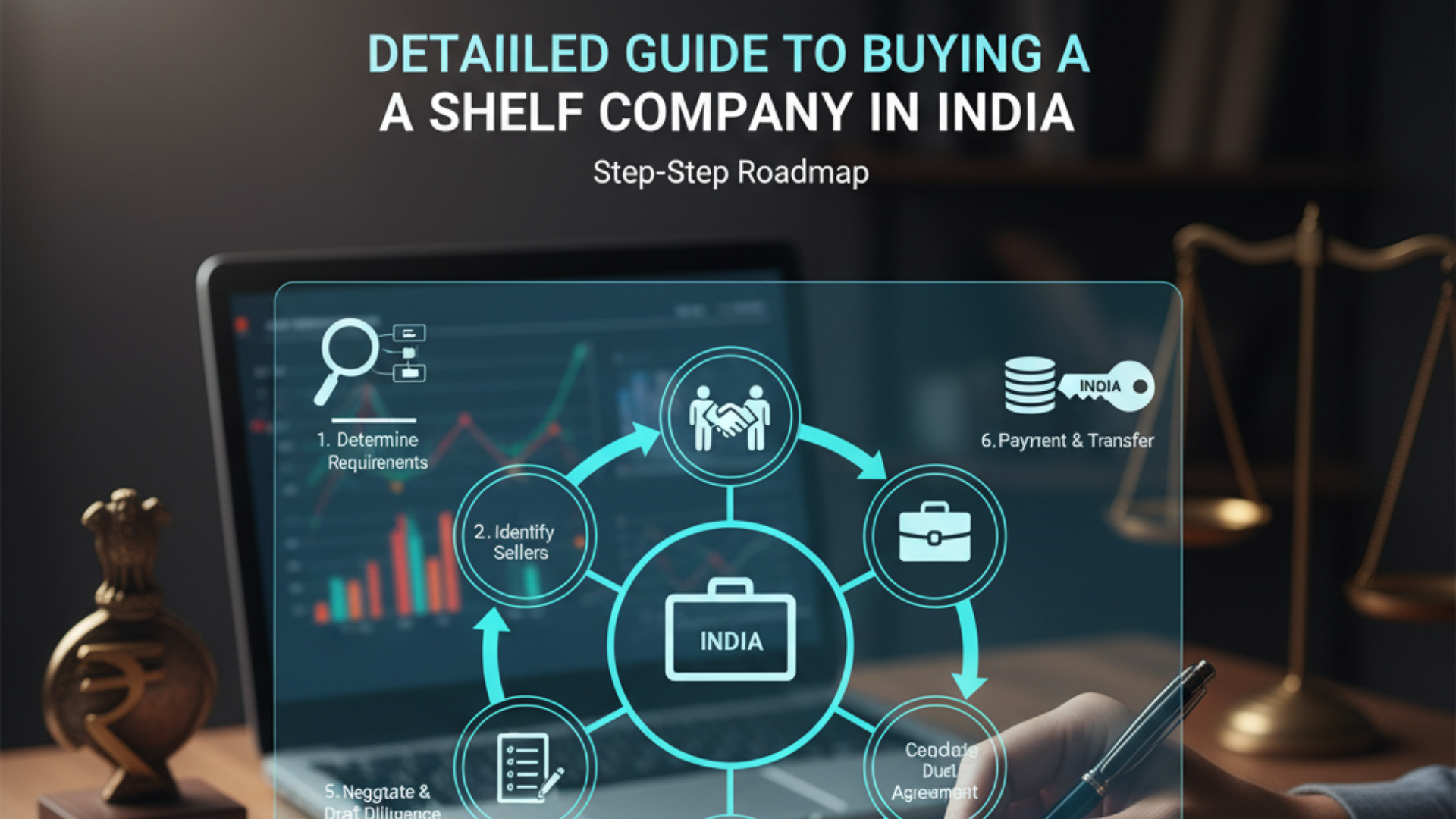
Buying a shelf company (or aged company) is basically like buying a pre-built house instead of starting new construction. It saves you a ton of time. Here’s how you can make that ready-made company yours:
6.1 The Prep Work: Knowing What You Want
- Define Your Dream Company: Don’t just buy the first thing you see. You need a company that actually fits your plans. Think about:
- The Name: Do you need to change it immediately?
- The Size ($$): Does the official starting capital (Authorized Capital) cover what you need?
- The Mission: Does the paperwork allow for the kind of business you actually want to run?
- Pro Tip: This is the best time to talk to an agent. They speak the regulatory language and will save you a headache later.
- Find Your Guide (The Seller): Skip the random Google searches for “shelf company for sale.” This is a major decision, so work with legitimate agencies or advisors you actually trust. They’ll help you navigate the process and make sure you’re not walking into a mess.
- Pick the Right ‘Age’: These companies come pre-aged, but a 2-year-old business isn’t the same as one that’s been around for 10 years. Check out your options and go with one that:
- Has a clean slate: No history of compliance failures.
- Matches your goals: Is the company’s past activity close enough to your future one?
6.2 The Big Check and The Handshake
- The Deep Dive (Due Diligence): This is the most critical step. You must make sure the company is 100% clean. Think of this as getting a full inspection before buying that house. A good agent will confirm:
- The company has no debts or financial messes.
- All filings with the RoC (Registrar of Companies) are up-to-date.
- You are buying a problem-free entity.
- Seal the Deal (Negotiate & Sign): Discuss the final price (including all transfer fees). Once you agree, you’ll draft and sign a formal Purchase Agreement. This document locks in all the terms and ensures you’re protected with warranties that the company is clean.
- Transfer & Pay (The Legal Handover): Once the money is paid, you sign the share transfer deed. The agent ensures the deed is properly stamped with the requisite Stamp Duty (based on share value). For foreign buyers, the agent manages the FEMA compliance, including filing Form FC-TRS with an Authorised Dealer Bank.
Statutory Filings & MCA V3 Verification Checklist
| Checkpoint | Action Required (The “Why”) | Crucial Document/Form |
| ROC Compliance Status | Check the company’s Master Data on the MCA website. Must be “Active.” | MCA Master Data |
| Annual Filings History | Verify that AOC-4 (Financial Statements) and MGT-7/7A (Annual Returns) were filed on time for all previous years. Late fees are a red flag. | AOC-4, MGT-7/7A |
| Director KYC Cleanliness | Confirm all old directors have completed their annual DIR-3 KYC. A failure here means immediate penalty and director disqualification. | DIR-3 KYC |
| Risk of Strike Off | Verify there are no notices issued by the RoC under Section 248. Avoid any company flagged for Suo Moto (self-initiated) strike-off due to dormancy or non-filing. | RoC Notices |
6.3 Making It Yours
- Change the Faces & Structure (Update Records): The company’s yours now. Time to get moving on these updates right away:
- Bring in new directors (file Form DIR-12).
- Refresh the shareholders’ list.
- Change the Name or What You Do (if needed): Planning to shift the business focus or rename it? Any big change to your business purpose (that’s the Objects Clause in your MoA) needs a Special Resolution and Form MGT-14 filed with the RoC. Don’t skip this compliance step.
- Get Your Permits (The Green Light): Depending on what your business does (e.g., finance, food, tech), you might need specific licenses or permits. Your consultant will help you navigate this industry-specific paperwork so you don’t start operating illegally.
- Get Tax-Ready (Compliance from Day One): Every company needs to be plugged into the tax system. Get your PAN (Permanent Account Number), GST registration, and any other mandatory registrations done immediately. Getting this right from the start avoids frustrating penalties later.
- Open the Doors (Bank & Branding):
- Open a company bank account in the new name.
- Make any final changes, maybe you want a new logo, a slight name change, or an adjustment to the company structure.
- Congratulations! All the administrative hurdles have been cleared. You can now confidently start doing business.
Financial & Tax Liability Mapping Checklist
| Checkpoint | Action Required (The “Why”) | Crucial Document/Form |
| Encumbrance Check | Run a search for any Charges registered against the company. This verifies there are no existing loans, mortgages, or collateral registered with the RoC (Form CHG-1/4). | Form CHG-1/4 |
| Tax and GST Cleanliness | Obtain a No-Demand Certificate or declaration from the sellers. Verify the company’s GST profile is active and has a zero-liability record for dormant periods. | GST Portal/Tax Orders |
| Bank Account Trail | Review the past 2-3 years of bank statements. Look for any suspicious or unexplained cyclical transactions (a tell-tale sign of a Shell Company). | Bank Statements |
The Takeaway: The “Pro Tip” is 100% correct. When you pay a professional to manage this process, you aren’t just buying a company; you’re buying speed and certainty. You get a clean, fully operational business without spending weeks dealing with government portals.
6.4 The Essential Value of Expert Protection
Given the serious risks buried in a company’s compliance history, attempting to buy a shelf or old company without expert help is like navigating a minefield blindfolded.
We are here for you. We don’t just handle documents; we’re in this with you as true partners, supporting you every step of the way. What we’re after is clear: reduce the risks, ensure the transfer is legally bulletproof, and provide you with a solid foundation to build on.
Here are the three essential ways we protect your acquisition:
6.4.1 Assess Legal Eligibility and Purpose Fit
Before any money changes hands, we run a strategic alignment check:
- Vetting the Target: We examine the company’s founding documents (Memorandum and Articles of Association) to verify it’s legally suited for the business activities you have in mind.
- Purpose Fit: We ensure the company’s current objects clause matches your objectives, cutting down on time-consuming post-purchase modifications.
6.4.2 Conduct Due Diligence & Compliance Audits
This is where things get serious. We become your detective team, digging past the polished exterior to find the risks lurking beneath:
Compliance Audit: We carefully examine all past filings (ROC, tax, GST, PF), hunting for gaps in documentation, outstanding penalties, or regulatory slip-ups.
Contingent Liability Check: We dig into any ongoing lawsuits, government notices, or disputed claims that could turn into your financial headache down the road.
6.4.3 Structure the Transfer and Handle ROC Filings
We make the legal transfer flawless. You need complete ownership that no one can challenge later, and we guarantee it.
- Structuring Your Takeover: We give you expert guidance on the smoothest, most tax-efficient way to transfer those shares and bring your new directors on board.
- Finalizing the Paperwork: We take care of all the mandatory filings with the Registrar of Companies (ROC). This officially moves control from the old promoters to you. It’s the government’s notice that the company is officially in your hands.
You get the speed and established reputation you want, and we make sure the legal process is so clean you’ll never face a surprise challenge later
Legal, Operational & Employee Legacy Checklist
| Checkpoint | Action Required (The “Why”) | Crucial Document/Form |
| Litigation Search | Obtain a declaration that the company is not a party to any ongoing litigation (civil, criminal, or regulatory). | Seller Declaration/Court Records |
| Labour Compliance (If operational) | Ensure all EPF/ESI/Gratuity payments and registrations were correctly handled for past employees. You inherit this risk. | EPF/ESI Records |
| Acquisition of Intellectual Property (Old Company Only) | If you’re buying an older company, double-check that any assets they’re claiming, like a Brand Name, Trademark, or Patent, are actually registered legally and can be transferred to you. | IP Registration Certificates |
The Takeaway: By engaging a professional, you are not just buying a company; you are buying a clean, fully operational business without spending weeks dealing with government portals and the uncertainty of hidden liabilities.
7. The 5-Step Share Transfer Procedure Under the Companies Act, 2013

Buying a shelf company is like taking over a car; you need the keys, but you also need the title transfer to be 100% legal. This final process ensures that, according to the law, you own the shares, and you control the company.
7.1. The Signing Ceremony: Formalizing the Deal (Form SH-4) 📝
This isn’t a simple receipt; it’s the legal instrument that proves ownership changed hands. Both the old owner and the new owner (you) sign the Share Transfer Deed (Form SH-4).
- What it means: You’re signing the “Bill of Sale” for the shares. Get this wrong, and the whole deal can be voided.
- The Crux: Ensure the form is officially stamped (like paying tax on the sale) and submitted to the company quickly; you only have 60 days from the signing date.
7.2. The Board’s Nod: Getting Internal Approval
Once the company receives the signed deed, the Board of Directors must convene a meeting. Their job is to officially look at the paperwork and say, “Yes, this transfer is valid and follows all company rules.”
- What it means: The company officially accepts you as the new owner. They pass a Board Resolution, basically, the internal go-ahead to update everything in your name.
- Why it matters: Sure, the seller might still control the Board right now, but this resolution is a required step that makes the whole transfer legitimate and above board.
7.3. The Official Ledger: Updating the Shareholder Roster
This is where it all becomes real. Once the Board approves everything, the company’s main internal record, the Register of Members (Form MGT-1), gets refreshed with the new ownership details.
- What it means: Your name goes in as a shareholder, and the seller’s name comes out. This is the real story of who owns the company now.
- The Next Step: The old share certificates are cancelled, and new share certificates are issued to you, confirming your ownership.
7.4. Public Takeover – Filing Forms with MCA V3 & Updating Directors
While the share transfer happens behind the scenes, the ripple effects it creates like switching up management, need to be out in the open for everyone, including the Registrar of Companies (RoC), to see. The previous owners usually kept nominee directors in place to maintain the company before selling it.
- Key Move: You file Form DIR-12 (Change in Directors) to remove those old placeholder directors and install your own people. This is when you officially take control of management.
- The Bigger Picture: Down the line, annual filings like MGT-7 (Annual Return) will publicly confirm that you’re the one running the show now.
7.5. Taking the Reins: Establishing Full Control
The final step is establishing full management and financial authority. Now that the shares are legally yours, your newly appointed Board of Directors can fully function.
- What it means: You’re not just a shareholder; you are now the controlling mind of the company. You appoint your own Auditors, authorize the new bank account (from the previous roadmap), and begin executing your business plan.
- The Result: The shelf company is no longer an “aged” entity; it’s your fully operational, legally compliant business, ready to trade.
Pro Tip: DIR-3 KYC is Non-Negotiable. Before the share transfer, ensure all old and new directors have completed their annual DIR-3 KYC filing. If a director’s KYC is overdue, their DIN (Director Identification Number) will be deactivated. Acquiring a company with deactivated directors is an immediate compliance failure that must be fixed before proceeding.
8. Final Thoughts – Advisory Note

Buying a shelf or an older company in India can cut weeks, maybe even months, off your setup time. But here’s the reality: speed can’t come at the expense of doing things right.
A smart purchase comes down to thorough due diligence, sticking to FEMA rules, and nailing every piece of paperwork. From transferring shares to filing the mandatory forms, each step counts if you want to avoid problems later on.
When you partner with pros who know what they’re doing, acquiring a shelf company turns into one of the quickest and most secure paths to start or scale your business in India. With proper guidance, you get a business that’s ready to roll while keeping everything above board legally.
Limited shelf companies are available. Book your consultation now
Q1: How long does it take to buy a shelf company in India?
The basic share transfer typically wraps up in 7–14 days, though getting all compliance updates sorted, including filings and regulatory approvals, might stretch to 3–6 months.
Q2: Can a shelf company be used immediately for bank loans or government tenders?
Yes, but there’s a waiting period. You’ll need to finish KYC procedures and update director/shareholder details first. Banks and tender boards want to see current, accurate company records.
Q3: What happens if FEMA filings are delayed?
Late filings can trigger penalties under FEMA Section 13, though you can often settle these through RBI applications. It’s much better to stay on schedule with compliance.
Q4: Is the prior business history of a shelf company a liability?
Not if you choose carefully. A proper shelf company shouldn’t carry any outstanding debts, legal disputes, or financial baggage. Just make sure you verify everything thoroughly beforehand.
Q5: Can I change the business activity of a shelf company after purchase?
Absolutely. You can modify the company’s Memorandum of Association (MoA) to match your planned business operations, once you get the green light from the RoC.
Q6: Are there additional costs besides the purchase price?
Yes, you’ll encounter transfer fees, stamp duty, professional charges, and compliance expenses. A good advisory team can break down the full cost picture upfront.
Q7: Can a shelf company have pre-existing directors and auditors?
Usually, yes. But you’re free to remove them or bring in new directors and auditors right after purchase to fit your business plans.